Delegating on a Faceless Channel: Stop Asking a Fish to Climb a Tree
You hired someone to edit. You hired someone to write. The money goes out on time every month and the work still does not move. So you sit there wondering whether you hired badly.
Usually you did not. Usually you handed the fish a tree and the monkey a lake, and then privately marked them both down as lazy.
I did that for years before anyone gave me language for it. This is the delegation playbook I ended up with – who gets which work, how to say it so it actually lands, and the one thing underneath all of it that decides whether any of it holds.
The better the hire, the faster a badly built team comes apart
This is the part that surprised me. A mediocre person in the wrong seat will grind along for months out of inertia. A genuinely good one will not. They know what work feels like when it fits, they can feel that this does not, and they leave first.
Which means the standard fix – “hire better people” – makes the problem arrive sooner rather than later if you have not worked out what each person is actually good at. Not good at in the sense of skills on a CV. Good at in the sense of the shape of work that does not cost them anything to do.
The three seats you are actually delegating into
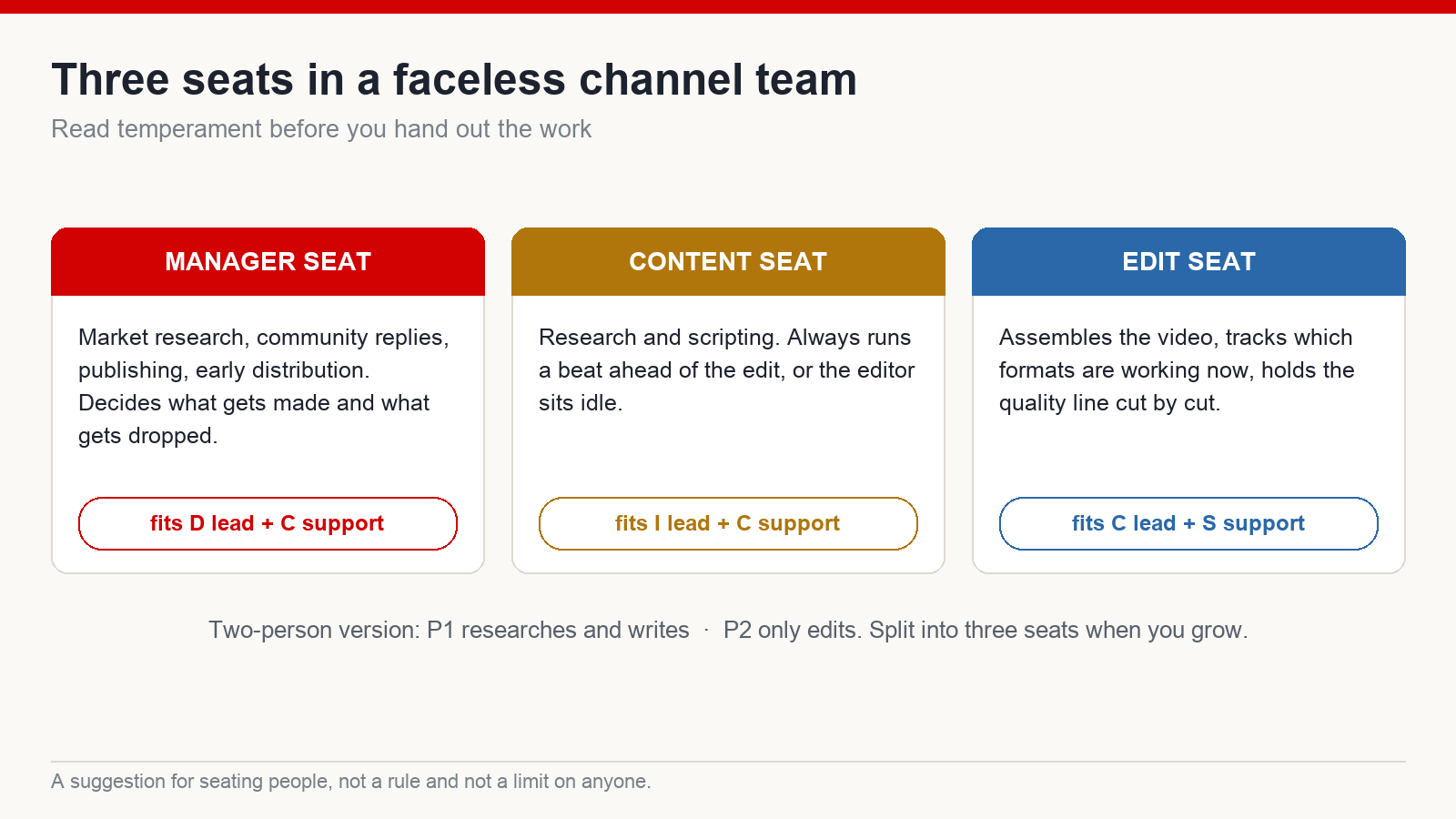
Before you can hand work over cleanly, you need to know what the handable units are. In a small faceless operation there are three, and they do not overlap as much as people assume.
The manager seat watches the market and decides. What is rising in the niche, which channels are climbing, which formats are working this month, whether your own output still resembles what the market rewards. Then the harder half: committing. This video gets made, that one gets dropped. Someone who decides quickly fits here, ideally with enough caution in the mix to check the numbers before calling it.
The content seat researches and writes, and it always runs a beat ahead of the edit. If the script is not ready, the editor sits idle and you pay for the idle time. This seat suits someone who can put themselves inside the head of a stranger in another country and write an opening that holds them – kept honest by enough discipline to stay inside the format rather than reinventing it every week.
The edit seat assembles. Exact cuts, music that lands on the beat, subtitles that break in the right place, and an eye on which edit styles are performing right now. Precision is the core requirement; durability is what lets someone do it on day forty as carefully as on day one.
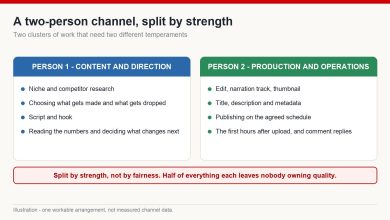
With two people rather than three, it collapses cleanly: one researches and writes, one edits. Split into three when the writing can no longer stay ahead of the edit.
Move one: hand work to the grain of the person
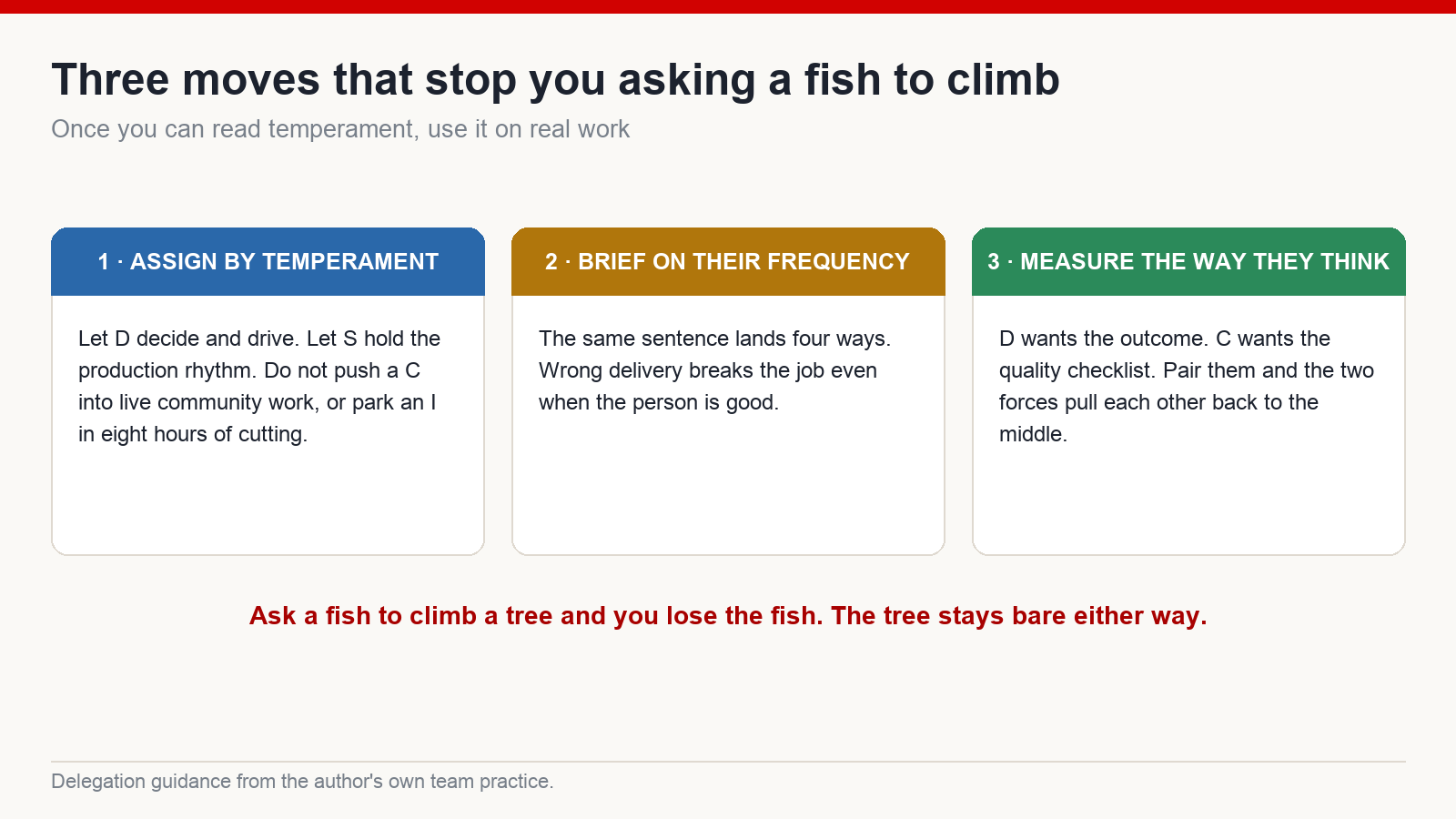
I had an editor once whose subtitle work was flawless – not one cut out of place across dozens of videos. To save on headcount I also gave him the community work: replying to comments, showing up in live chats, pushing the first hours of distribution. He froze. Typed three replies, closed the laptop, and after a few weeks of that we were done.
He was not bad at it in the way you would coach out. Crowds genuinely drained him, and I had made crowds his afternoon.
The reverse costs the same. Someone whose gift is reading an audience – who writes a line and you can feel it land – put on eight hours a day of frame-level assembly is being kept in a room with the lights off. Two weeks, maybe three, then the message arrives.
Seated with the grain instead: let the decisive one decide and drive. Let the steady one own the production rhythm, the thing that quietly keeps a channel alive. Do not push a precision-first person into live community work, and do not park a people-first person in a full day of cutting.
Move two: brief on the person’s own frequency
The same sentence, delivered the same way to four people, works on one of them. That was the most expensive small thing I ever learned.
- To the decisive one: short. Target, deadline, done. Three sentences of preamble and you have lost their attention and some of their respect.
- To the ideas-and-people one: acknowledge what worked before you say what needs changing, then show them where the channel is going. They run on that.
- To the steady one: signal changes in advance. Do not swap the schedule or the method on them at five in the afternoon.
- To the precision one: skip the encouragement. Bring the numbers, the checklist and the reason. Evidence is what settles them, and nothing else will.
A wrong delivery breaks a job even when the person is entirely capable of the job. It is worth reading that twice, because it means some of your delivery problems are not delivery problems at all.
Move three: measure with the yardstick they already use
Ask the results-driven person how the video did and they will answer instantly – they have been tracking it anyway. Ask the precision-driven person the same question and you will get a shrug, because they have been tracking whether it was built correctly.
Review each of them on the thing they were already measuring. Then, where you can, put those two on the same piece of work. One pushes for pace, the other holds the standard, and the tension between them lands somewhere better than either would alone.
Then look at the mix of the whole team
Once you can read individuals, read the room. A team where everyone is ideas-and-people is enjoyable and permanently late – it needs somebody precise. A team of careful, steady people is unbreakable and slow, always a month behind whatever is working now – it needs decisiveness and instinct.
There are months where nobody underperformed, the money went out as usual, and the work still did not come out. Often that is not a person failing. It is a whole team missing one register.
The trap: a label is not an excuse
Here is where this whole way of thinking goes wrong, and it goes wrong fast.
You hand someone a detailed, fiddly task and hear: “That is not really my style, I am more of a big-picture person.” It sounds like self-awareness. It is not. It is borrowing a framework to get out of the boring part of the job.
Whatever anyone’s grain is, the fundamentals of the craft are still the fundamentals. A writer still follows the thumbnail-title-script format. An editor still helps with distribution in the first hours when it matters. Reading temperament exists to make work land more lightly on people, not to hand anyone a certificate excusing them from discipline.
The same applies to how you use it on other people. It is a reference for how somebody tends to behave, not a measure of what they can do, and behaviour shifts with context anyway. Somebody flat in a meeting can be on fire doing the thing they love. Use the map to assign work. Do not use it to decide who someone is.
Delegation without a written process is just hoping
Now the part that decides everything above. You can seat everyone perfectly and the team can still go nowhere, because the real bottleneck in this work has never been intelligence.
In my experience teaching creators, the thing that stops most of them is that they will not follow a process they have already been given. They substitute their own preferences for the sequence, at the exact stage when they have not yet run the sequence correctly once. That is my own observation over years of coaching rather than a measured figure, but I now assume it by default.
I sat in a session once where a room of people, each holding a printed checklist, was asked to put four coloured pens in a stated order. Nobody opened the sheet in their hand. It was not hard. It was a discipline problem, and discipline reveals itself in the smallest task available.
There is a strange piece of evidence for this from the tooling side. The reason so much of this work can now be handed to AI is not that the steps got easier – it is that a machine has no instinct to skip one. It does not decide halfway through that it already knows better. Which tells you the process was never the hard part.
So every seat gets a checklist. Lettered sections, numbered steps in order inside each one, ticked as they are done. Spreadsheet, or printed and taped next to the monitor. It is basic to the point of feeling silly. It is also what keeps three people working like a team rather than three people in a group chat.
Three things to do this week
- Watch, for a few days. No test, no questionnaire. Just notice what each person – including you – reaches for first and what they avoid.
- Move exactly one task. Find the one job that is clearly against somebody’s grain and swap it with someone it suits better. One. Small enough that nothing breaks if you read it wrong.
- Write the checklist for one seat. Not all three. One. Then follow it exactly as written for two weeks before you improve it. Do first, understand after.
None of this makes a channel grow on its own, and results vary enormously with niche, market and effort. What it does is stop you burning through good people while you find out what actually works.
Frequently asked questions
Is a behavioural model like DISC a hiring test?
No, and using it as one is a mistake. It is a reference for how a person tends to work so you can hand them the right kind of task. It does not measure ability, it is not a psychological diagnosis, and behaviour changes with the situation. Never make it the deciding factor on hiring or letting somebody go.
What if my whole team is me?
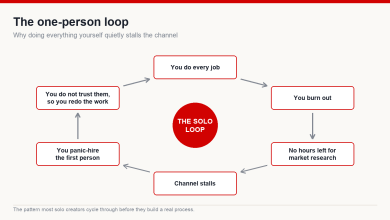
Then read your own grain first. Most solo creators keep doing the part of the job they enjoy and quietly starve the part they do not – which is usually why the channel stalls in one specific place. Name that part, and make it the first thing you hand off or systematise.
How do I delegate without losing quality?
Hand over the process, not just the task. A brief describing the outcome invites interpretation; a numbered checklist with a definition of done leaves far less room for it. Quality drops when people are guessing at your standard rather than reading it.
Is seating people correctly enough to make a team work?
It is about half. The other half is process discipline – one shared task board, one shared drive, a checklist per seat, and nobody skipping steps because they feel confident. In what I have seen, most teams that stall are not badly seated. They are improvising.
How many people does a faceless channel need?
Two is a working minimum: one researching and writing, one editing. Three when writing can no longer stay ahead of the edit. Adding people before there is a written process to hand them just multiplies the confusion, and it raises your costs long before it raises anything else.
I have been building faceless channels for English-speaking audiences since 2017, and everything here was learned the expensive way, on real people who deserved better management than I was giving them. If you want to go further into building that kind of channel with a team behind it, that is what I write about at mmoyoutube.com.